
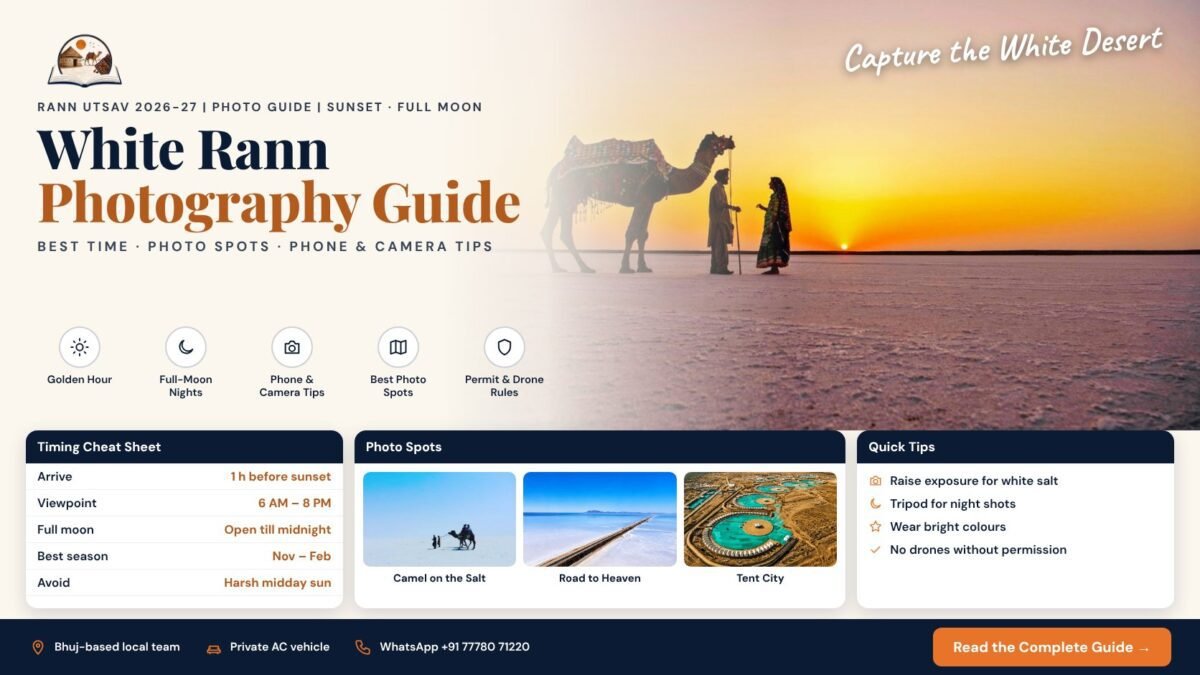
The White Rann of Kutch is one of the most photographed places in India: endless white salt, dramatic skies, golden sunsets and silver full-moon nights. But the same white desert that looks magical to your eyes can fool your camera — washed-out photos, grey salt, dark faces and blurry night shots are common. This White Rann photography guide covers the best times, the best photo spots around Dhordo, camera and phone settings that work on white salt, full-moon tips, what to wear for photos, and the rules you need to know.
White Rann Photography — Quick Answer
| Best light | The hour before sunset, sunset and twilight; sunrise for soft light and fewer people |
| Arrive | At least 1 hour before sunset |
| Viewpoint timings | 6:00 AM to 8:00 PM; until midnight on full-moon nights during Rann Utsav |
| Best season | November to February (Rann Utsav), when the salt is at its whitest |
| Must carry | Sunglasses, a tripod or phone stand for night shots, a light jacket, original photo ID |
| Entry | White Rann permit required |
Best Time for Photos at the White Rann
Sunset (the classic)
The signature White Rann shot: the sky turns gold, pink and orange and the salt reflects it. Arrive at least an hour before sunset — it takes time to walk out onto the salt, away from the crowds, and the light keeps changing for a while after the sun goes down. Twilight, just after sunset, often gives the softest pastel colours.
Sunrise
The viewpoint opens at 6:00 AM. If you are staying at Tent City or nearby, sunrise gives soft light and far fewer people — ideal for clean, empty-horizon photos.
Full-moon nights
On full-moon nights during Rann Utsav, the salt glows silver and the viewpoint stays open until midnight. Full moons in the 2026-27 season fall on 23 Nov and 23 Dec 2026, 22 Jan and 20 Feb 2027. These dates are popular, so book early — see the best Rann Utsav dates.
Midday — avoid for photos
Harsh overhead sun makes the salt glare, flattens the landscape and gives hard shadows on faces. Use the middle of the day for other sightseeing.
Best Photo Spots Around the White Rann
- White Rann viewpoint, Dhordo: walk past the busy entry area until you have unbroken salt to the horizon.
- Camel cart on the salt: a traditional camel cart against the white desert makes a classic Kutch picture.
- Tent City at dusk: rows of lit tents just after sunset — a favourite for wide shots.
- Kala Dungar: the highest point in Kutch, with a panoramic view over the Rann at sunset. Photos are not allowed near the army post at the top.
- Road to Heaven: a straight road across the salt flats from Khavda to Dholavira — one of the most photographed roads in India.
- Hodka village: embroidery and decorated mud-mirror homes for colourful culture shots — always ask before photographing people.
Want to be on the salt at the right time? We plan your White Rann visit around sunset or the full moon, with a private vehicle from Bhuj. Chat on WhatsApp or call +91 77780 71220.
Camera and Phone Settings for White Salt
Fix grey-looking salt
Cameras try to make everything “average” brightness, so bright white salt often comes out dull grey. To fix it:
- Phone: tap the screen to focus, then slide the brightness (exposure) control up a little until the salt looks white again.
- Camera: add exposure compensation, roughly +0.7 to +1, and check the picture on screen.
- Do not overdo it: if the sky turns pure white with no detail, bring the brightness back down.
Sunset settings
- Tap on the bright sky to keep the colours, then lighten faces gently or use a little fill light.
- Try HDR mode on phones for scenes with a bright sky and darker ground.
- Shoot a few frames as the light changes every few minutes — the best colour is often after the sun has gone.
Full-moon and night settings
- Use a tripod or phone stand — low-light shots need a steady camera.
- Use night mode on your phone and keep still until the shot is finished.
- On a camera, use a longer shutter speed with a tripod and a 2-second timer to avoid shake.
- Switch off flash for landscapes — it only lights the salt near your feet.
What to Wear for White Rann Photos
- Bright colours: red, yellow, orange, blue or traditional Kutchi outfits stand out beautifully against white salt.
- Avoid all-white clothes — you will disappear into the background.
- A dupatta, stole or scarf gives movement in the breeze for natural-looking photos.
- Layers for the evening: desert nights get chilly from December to February, so carry a light jacket. See what to wear at Rann Utsav.
Photo Ideas to Try
- Silhouettes at sunset: shoot towards the sun so people become dark outlines against the coloured sky.
- Perspective tricks: the flat, empty salt makes fun forced-perspective photos easy — a friend “standing on your palm”.
- Jump shots: use burst mode on your phone.
- Salt patterns: get close to the ground for the cracked hexagon-like patterns in the salt crust.
- Wide, empty horizon: place the horizon low in the frame to fill the picture with sky at sunset.
Rules and Practical Tips
- Permit: the White Rann is near the international border, so a permit is required. Carry original photo ID. See our White Rann permit guide.
- Drones: the area is close to the border, and drones near the border need special permission. Do not fly one unless you have clearance.
- No photos at army posts, including the one at the top of Kala Dungar.
- Protect your eyes and skin: the salt reflects sunlight strongly — wear UV sunglasses, sunscreen and a hat in daylight.
- Protect your gear: salt dust and moisture can stick to lenses; wipe them with a soft cloth.
- Charge everything: carry a power bank — cold evenings drain batteries faster.
- Stay hydrated: carry water even in winter.
- Ask before photographing people in villages and at craft stalls.
Plan Your Photography Trip
For the best photos, stay at least one night near the White Rann so you can shoot both sunset and sunrise, or come for a full-moon night. Our packages include the White Rann sunset, Kala Dungar, the Road to Heaven and Dholavira:
| Package (Silver) | 2 travellers (per person) |
|---|---|
| 1N / 2D — White Rann | ₹5,300 |
| 2N / 3D — White Rann, Kala Dungar, Dholavira | ₹8,550 |
| 3N / 4D — adds Mandvi | ₹11,600 |
GST (5%), lunch, the permit and entry fees are extra. Rates vary by date. Prefer Tent City? See Tent City Dhordo.
Frequently Asked Questions
What is the best time to photograph the White Rann?
The hour before sunset through twilight, and sunrise. Arrive at least an hour before sunset. The best season is November to February.
Why does the white salt look grey in my photos?
Cameras darken bright scenes. Increase the exposure slightly on your phone or camera until the salt looks white again, without losing the sky.
Can I take photos at night?
Yes, especially on full-moon nights during Rann Utsav, when the viewpoint stays open until midnight. Use a tripod or phone stand and night mode.
Can I fly a drone at the White Rann?
Only with special permission, because the area is close to the international border.
What should I wear for photos?
Bright colours or traditional Kutchi outfits. Avoid all-white clothes, and carry a light jacket for the evening.
What are the White Rann timings?
Usually 6:00 AM to 8:00 PM, extended until midnight on full-moon nights during Rann Utsav. Timings can vary, so check before you go.
Book Your White Rann Photography Trip
We are a local team in Bhuj. Tell us your dates and whether you want sunset, sunrise or a full-moon night, and we will plan your trip and timing.
Chat on WhatsApp · Call +91 77780 71220 · Send an enquiry
Ready to Explore Kutch?
Let our local Bhuj-based experts plan your perfect Kutch trip — White Rann tours, Rann Utsav stays, Dholavira, Mandvi, and beyond. WhatsApp us for a custom itinerary.